Skip to the content
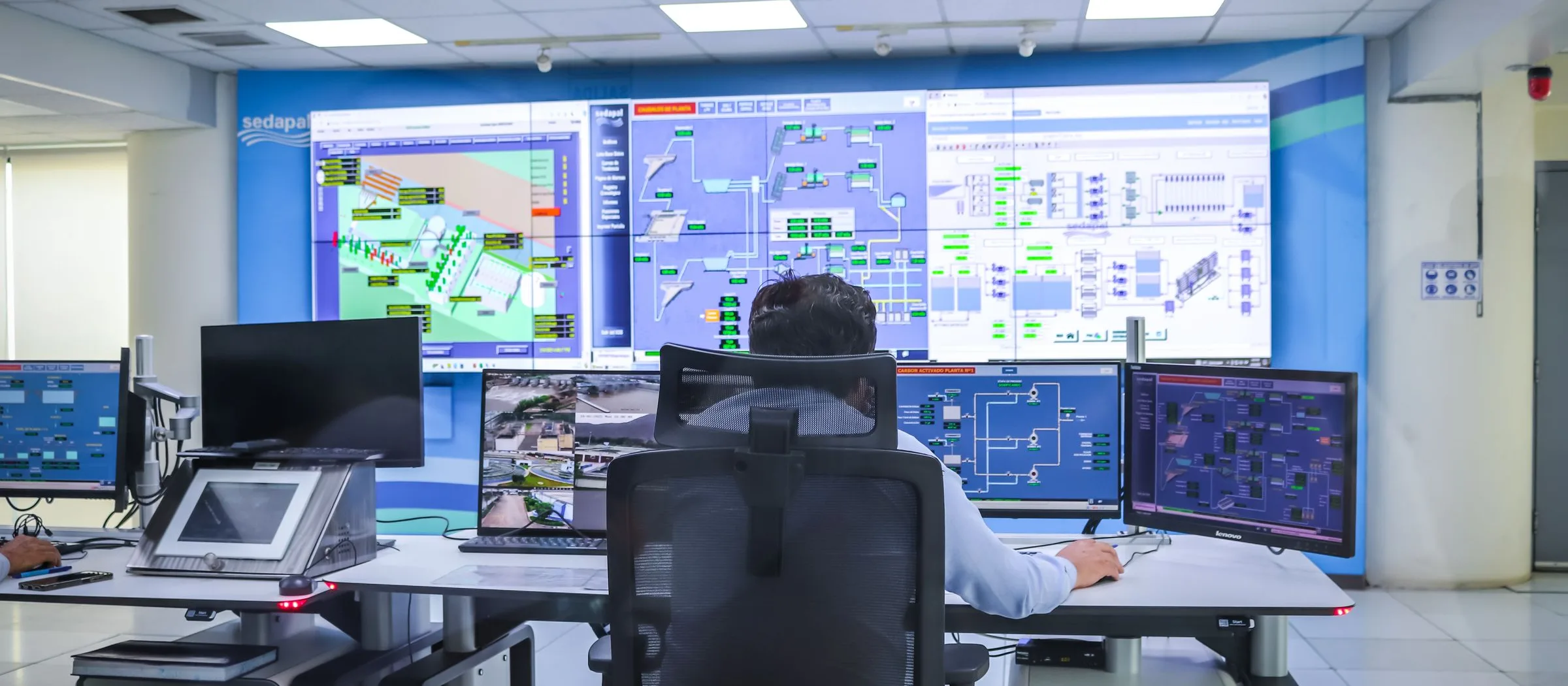
An operator at a control desk before a wall of system displays

Building Management and Automation

Building management systems, from the field devices and controllers to the operators' view of every plant.

We design, supply, install, test and commission the building management systems of buildings, and maintain the systems we installed: the field devices that measure and move the plant, the controllers that run it, the network that joins them, and the servers and workstations from which the engineers watch it. A system runs the heating, cooling, air conditioning and ventilation to their schedules and set points, and brings into one view the plant that comes with controls of its own: chillers, generators and switchgear, lighting, lifts, fuel, solar and pneumatic tube systems, and the alarms of medical gas and isolated power.

The design starts from the plant and how it must run. With the mechanical and electrical designs we write the sequence of operation of each system, from ASHRAE Guideline 36 where it fits, and the points schedule, every input, output and network point with its alarm limits, from which we size the controllers, the panels and the network. We specify open protocols, BACnet to ISO 16484-5 between the controllers and the operators, with Modbus, M-Bus, KNX or DALI at the plant that uses them, so that the owner is not bound to one maker, and agree with the client the efficiency class of EN ISO 52120-1 the building is to reach.

We supply the controllers, panels, field devices, valves and software, and our teams install and wire them on site. Each point is tested from the field device to the operators' graphic, each sequence is proved with the plant running, and trend logs show every system holding its set points before handover. Under a service contract we then maintain the systems we installed: sensors checked and calibrated, controllers and software kept current, and alarms and trends reviewed with the building's engineers.

Controllers, field devices and sequences

Each plant has its own controller, so that a fault in one stops no other: a building controller for each plant room, an advanced application controller for each air handling unit or chiller plant, and application specific controllers for fan coil units, terminal units and rooms, each listed by BACnet Testing Laboratories for its profile. Life safety stays hardwired from the fire alarm: the system watches the smoke control and fire dampers but never stands between the detection and the plant it stops.

We choose each sensor for the accuracy its loop needs, commonly to within 0.3 K for temperature and 2 per cent relative humidity in rooms, size control valves for their authority, or pressure-independent where the flow must hold, and give spring-return actuators to the dampers that must close when the power fails. Each panel leaves commonly 20 per cent of its points spare. In a hospital the plant's controllers run from the essential distribution with a UPS, so that they restart the theatres' ventilation and hold the isolation rooms' pressures when the generators take over.

Integration, alarms and energy

Plant with controls of its own joins the system over BACnet or Modbus, or over IEC 61850 for medium-voltage switchgear: chillers, boilers, generators and switchgear, the lighting controls, the lifts, the fuel, solar and pneumatic tube systems, and the medical gas and isolated power alarms. The system repeats those alarms to the engineers but never replaces the alarm panels the standards require where the clinical staff work. It runs on a network of its own, apart from the clinical and business networks, with BACnet Secure Connect where the controllers support it.

The operators see each plant as a graphic with its live values and its alarms in classes; the critical ones, such as a theatre's ventilation, an isolation room's pressure or a mortuary store's temperature, go at once to the engineers on duty. Trend logs record every point, commonly every 15 minutes, and the meters of electricity, chilled water, heat and water report by system and by tenant, so that the energy each uses can be seen, and the building keeps the efficiency class agreed under EN ISO 52120-1.

Systems and equipment

Supervisory level

  • Servers: the system's database, graphics, alarms and trend logs, with a standby server in a hospital
  • Operator workstations: plant graphics, alarm lists and reports in the engineers' office
  • Alarm notification: critical alarms sent to the phones of the engineers on duty
  • Energy reports: consumption by system, by floor and by tenant

Controllers and panels

  • Building controllers: one for each plant room, listed by BACnet Testing Laboratories for their profile
  • Plant controllers: for each air handling unit, chiller plant, boiler plant and pump set
  • Room and terminal controllers: for fan coil units, air terminal units and the rooms they serve
  • Control panels: with their power supplies and spare points, beside the plant they run

Field devices

  • Sensors: temperature, humidity, pressure, flow, carbon dioxide and air quality
  • Control valves: two-port and three-port, or pressure-independent where the flow must hold
  • Actuators: for valves and dampers, spring-return where they must close when the power fails
  • Meters: electricity, heat, chilled water and water, read over M-Bus, Modbus or BACnet

Integration

  • Packaged plant: chillers, boilers, generators and pump sets over BACnet or Modbus
  • Electrical systems: switchgear over IEC 61850 or Modbus, UPS systems and the lighting controls
  • Hospital systems: medical gas and isolated power alarms, room pressure monitors and cold stores
  • Other systems: lifts, fuel, solar and pneumatic tube systems, and the fire alarm's states, watched only

Standards we work to

  • ISO 16484-2: building automation and control systems, hardware
  • ISO 16484-3: building automation and control systems, functions
  • ISO 16484-5 and ASHRAE 135: BACnet, a data communication protocol for building automation and control networks
  • EN ISO 52120-1: the contribution of building automation, controls and building management to the energy performance of buildings
  • ASHRAE Guideline 36: high-performance sequences of operation for HVAC systems
  • ASHRAE 90.1: energy performance of buildings