Skip to the content
A fingerprint access control reader beside a glass door

Security Systems and Access Control

Access control at doors and gates, intruder and hold-up alarms, and the security management that joins them.

We design, supply, install, test and commission the security systems of buildings, and maintain the systems we installed: access control at the doors, gates and lifts that need it, intruder and hold-up alarms, door intercoms, visitor and key management, and the security management system that brings their alarms to the control room beside the pictures of the cameras. The cameras and their recording have a page of their own, with telephony, IPTV and signage.

The design starts from the security brief: what each part of the building holds, who may enter it and when, and the risks it faces. From it we set the grade of each area, the doors that take a reader on one side or on both, the rooms an intruder alarm protects, and where hold-up alarms and intercoms are needed, and we design the door hardware with the architects so that every door on an escape route still opens for anyone leaving in an emergency. In Dubai the systems follow the requirements of SIRA, the Security Industry Regulatory Agency, for the building's type.

We supply the controllers, readers, locks, detectors and software, and our teams install them on site with the door hardware. Each door is tested for every way it opens and locks, each detector is walk tested, and the alarms, the release of the doors on the fire alarm and the links to the cameras are proved before handover. Under a service contract we then maintain the systems we installed: locks and readers checked, detectors tested, batteries renewed, and the access rights reviewed with the security team.

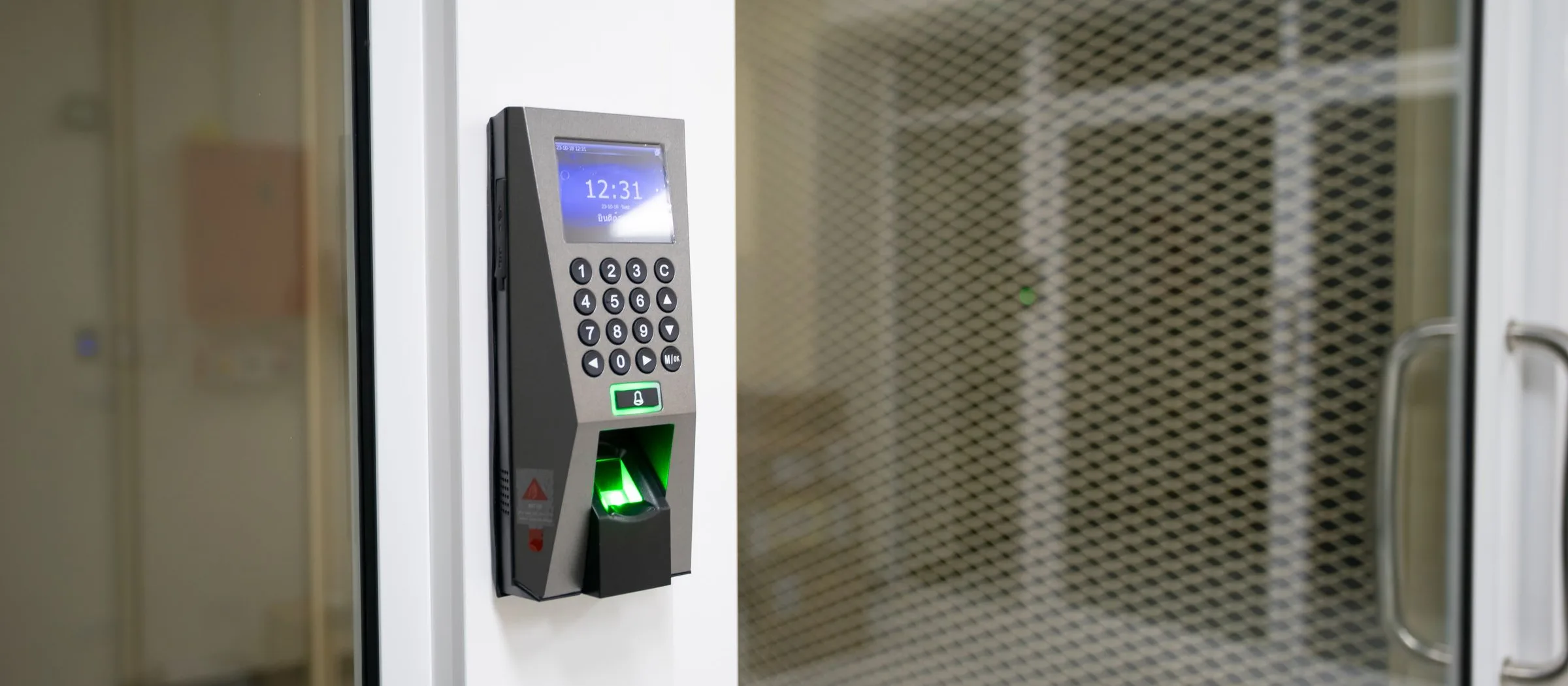
Access control and doors

Each controlled door has a reader, a lock and a door contact, wired to a controller that decides by itself whether a card may open it, even without the network. Readers talk to their controllers over the secure channel of OSDP, the protocol of IEC 60839-11-5, rather than Wiegand, which carries a card's number in clear, and the cards hold encrypted credentials, with a PIN or a biometric added where a room needs two factors. We grade each door under IEC 60839-11-1, from grade 1 for an office floor to grade 3 for a pharmacy store or a data hall.

The fire alarm unlocks the doors on escape routes, their release actuated to BS 7273-4, and a green release beside each door opens it under EN 13637; their electromagnetic locks release on a power failure. Doors that must stay secure take motorised locks that a handle on the inside always opens. We interlock the doors of cleanroom airlocks so that they cannot open together, and the doors into an MRI suite's controlled area open only for screened staff.

Intruder alarms and hospital security

Intruder and hold-up alarms follow EN 50131: we grade each system for its risk, commonly grade 2 for offices and shops and grade 3 for pharmacies, controlled drug stores, data halls and cash offices, with detectors, door contacts and hold-up buttons of that grade, and send the alarms to the monitoring the client or the authority names. The security management system brings the access, intruder and camera alarms to one screen in the control room, with the plan of the building, the door that raised the alarm and the camera that sees it.

In a hospital, maternity and neonatal units lock their doors and raise the alarm when a tagged baby is carried towards an exit; mental health units take readers and fittings that leave nothing to tie a ligature to; and pharmacies keep their controlled drugs behind two-factor doors that record every entry. Staff in the emergency department carry personal alarms that show where help is needed, and the department can be locked down from its reception at a button.

Systems and equipment

Access control

  • Door controllers: deciding at the door, so that each keeps working if the network fails
  • Readers: encrypted cards and mobile credentials, with a PIN or a biometric where two factors are needed
  • Locks: electromagnetic, motorised or electric strike, each chosen for its door and its escape route
  • Emergency door releases: green releases beside the doors on escape routes, to EN 13637
  • Turnstiles and speed gates: at the entrances of offices and staff areas

Intruder and hold-up alarms

  • Control panels and keypads: graded to EN 50131 for the risk
  • Detectors: dual-technology movement detectors, door contacts and glass break detectors
  • Hold-up buttons: at receptions, pharmacy counters and cash offices
  • Alarm transmission: to EN 50136-1, to the monitoring the client or the authority names

Hospital security

  • Infant protection: tags that lock a maternity unit's doors when a baby is carried towards an exit
  • Personal alarms: for staff in emergency departments and mental health units, showing where help is needed
  • Controlled drug stores: two-factor doors that record every entry
  • Lockdown: an emergency department closed from its reception at a button

Management and entry

  • Security management system: access, intruder and camera alarms on one screen, with the building's plans
  • Door intercoms: video door stations at the entrances of wards and units
  • Visitor management: passes issued at reception for the areas and hours of the visit
  • Key management: electronic cabinets that release each key to authorised staff and record it

Standards we work to

  • EN 50131-1: alarm systems, intrusion and hold-up systems, system requirements
  • EN 50136-1: alarm systems, alarm transmission systems and equipment, general requirements
  • IEC 60839-11-1: electronic access control systems, system and components requirements
  • IEC 60839-11-5: electronic access control systems, the open supervised device protocol
  • EN 13637: building hardware, electrically controlled exit systems for use on escape routes
  • BS 7273-4: the operation of fire protection measures, the actuation of release mechanisms for doors
  • The requirements of the UAE's security authorities, those of SIRA in Dubai among them
  • The local authority codes of the UAE, the UAE Fire and Life Safety Code of Practice among them