Skip to the content
Rows of outdoor cooling units on either side of a paved walkway

Cooling Systems

Chiller plants, cooling towers and district cooling stations, with the chilled water systems they feed.

We design, supply, install, test and commission the cooling plants of buildings, and maintain the systems we installed: air-cooled and water-cooled chillers, the cooling towers and condenser water systems that reject their heat, thermal energy storage, the energy transfer stations of buildings on a district cooling network, and the pumps, pipework and controls of the chilled water systems that carry the cooling to the air handling units and fan coil units. In the Gulf cooling is the largest load of most buildings, and in a hospital or a data centre it must not stop.

The design starts from the cooling load of each room and of its fresh air, calculated hour by hour for the design day of the site; in Dubai the municipality's design outdoor condition is 46 °C dry bulb and 29 °C wet bulb. We choose the chilled water temperatures, commonly a supply of 6 to 7 °C and a return of 12 to 13 °C, or those a district cooling provider sets, size the plant so that the peak load is met with one chiller out of service, and select the chillers for their efficiency at part load, where they run for most of the year, to ASHRAE 90.1.

We supply the chillers, pumps, heat exchangers and valves, those of the brands we carry among them, and our teams install, pipe and wire them on site. The chilled water and condenser water systems are pressure tested, flushed and chemically cleaned, each chiller is started up by its manufacturer and run against its rated capacity, and the systems are balanced and their controls proved before handover. Under a service contract we then maintain the systems we installed: the chillers serviced to their manufacturers' schedules, their tubes cleaned, the cooling towers cleaned and their water treated and tested.

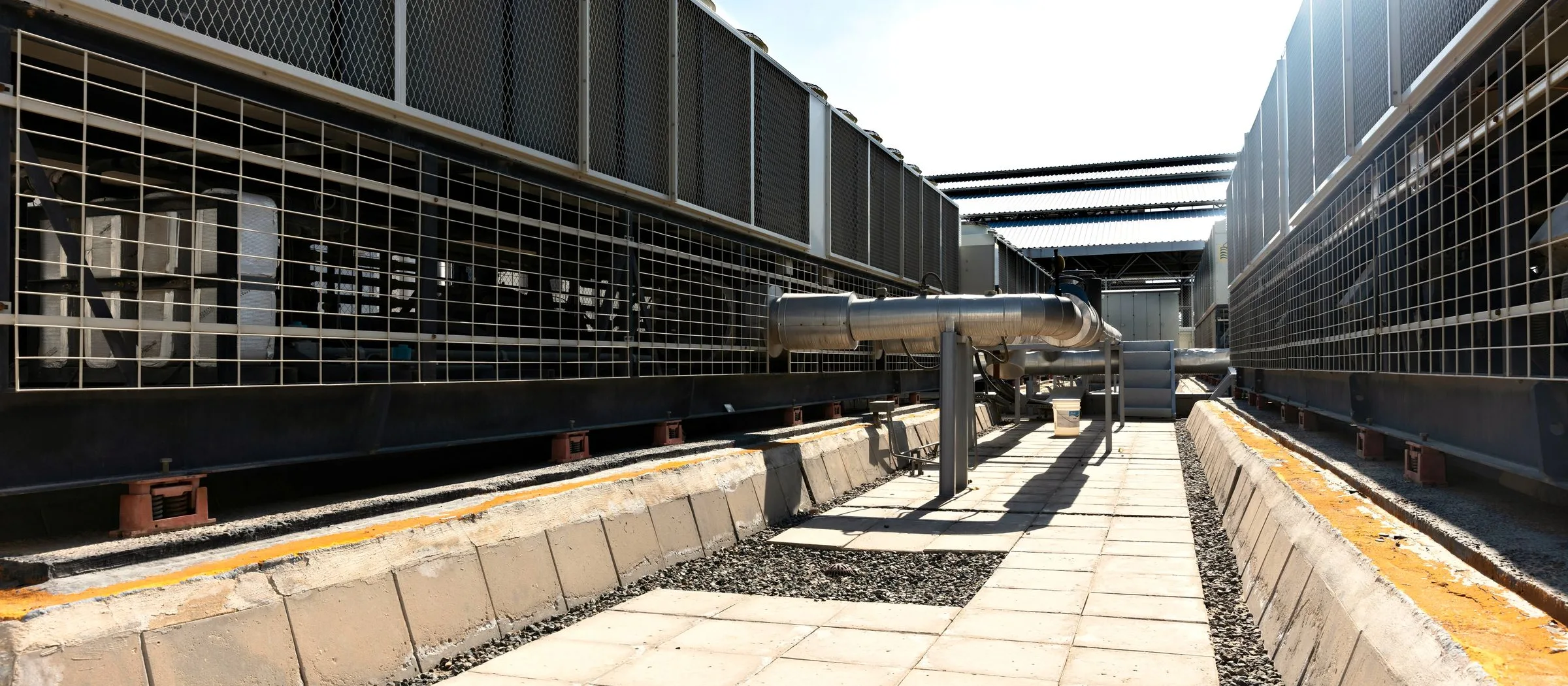
Chillers and heat rejection

Air-cooled chillers stand on the roof or at grade with room around them for their air. We select them for an entering air above the 46 °C of the design day, since the roof's heat and the discharge of neighbouring units raise it. Water-cooled centrifugal and screw chillers reject their heat to cooling towers and use less energy, which pays where the plant is large and make-up water for the towers can be had, treated sewage effluent where the authority requires it. At a wet bulb of 29 °C their condenser water commonly enters at about 32 °C and leaves at about 37 °C, and we size the towers for that duty.

Each tower has drift eliminators, a treatment and bleed system that holds the water's cycles of concentration, and a water management programme under ASHRAE 188, and stands where its drift cannot reach a fresh air intake. Where the tariff or the size of the plant rewards it, thermal energy storage in chilled water tanks or ice is charged at night and takes the daytime peak.

Chilled water systems and district cooling

Most plants we design are variable primary flow systems: variable speed pumps move only the water the load needs, each chiller is selected to accept a flow that varies down to its evaporator's minimum, which a bypass valve holds at low load, and every coil has a two-port control valve, pressure independent where the circuits are long, so that the return stays warm and the chillers stay efficient. A return colder than designed is the commonest reason a plant cannot deliver its capacity, so we design against it from the selection of each valve.

A building on a district cooling network takes its chilled water through an energy transfer station: plate heat exchangers, commonly two or more sharing the load, that separate the provider's water from the building's, with the provider's control valve and energy meter. We design the station to the provider's requirements for the approach across the exchangers and for the return temperature, which the tariff often penalises when it falls short.

Systems and equipment

Chillers

  • Air-cooled chillers: screw or scroll compressors, rated for an entering air above 46 °C
  • Water-cooled chillers: centrifugal or screw, with variable speed compressors for part-load efficiency
  • Modular chillers: units in parallel that stage with the load and can be added to later
  • Heat recovery chillers: hot water for reheat and domestic use from the heat the plant rejects

Heat rejection

  • Cooling towers: open or closed circuit, with drift eliminators, sized for the site's wet bulb
  • Condenser water pumps: one for each chiller or on a common header, with a standby
  • Condenser water treatment: dosing, bleed control, side-stream filtration and Legionella monitoring

Chilled water distribution

  • Chilled water pumps: variable speed, variable primary or primary and secondary, with standby units
  • Pipework: insulated steel pipework with a vapour barrier, its supports and its expansion joints
  • Control valves: pressure independent and two-port valves with their actuators at every coil
  • Buffer tanks and expansion: buffer vessels, pressurisation units and expansion vessels

District cooling and storage

  • Energy transfer stations: plate heat exchangers, control valves and energy meters to the provider's requirements
  • Thermal energy storage: stratified chilled water tanks or ice storage charged at night
  • Plant controls: chiller sequencing, pump and tower control, and the plant's energy metering

Standards we work to

  • AHRI 550/590: the performance rating of water-chilling and heat pump water-heating packages
  • EN 14511: air conditioners, liquid chilling packages and heat pumps with electrically driven compressors
  • CTI STD-201: the performance rating of evaporative heat rejection equipment
  • EN 378: refrigerating systems and heat pumps, safety and environmental requirements
  • ASHRAE 15: the safety of refrigeration systems
  • ASHRAE 188: Legionellosis, risk management for building water systems
  • ASHRAE 90.1: energy performance of buildings