Skip to the content
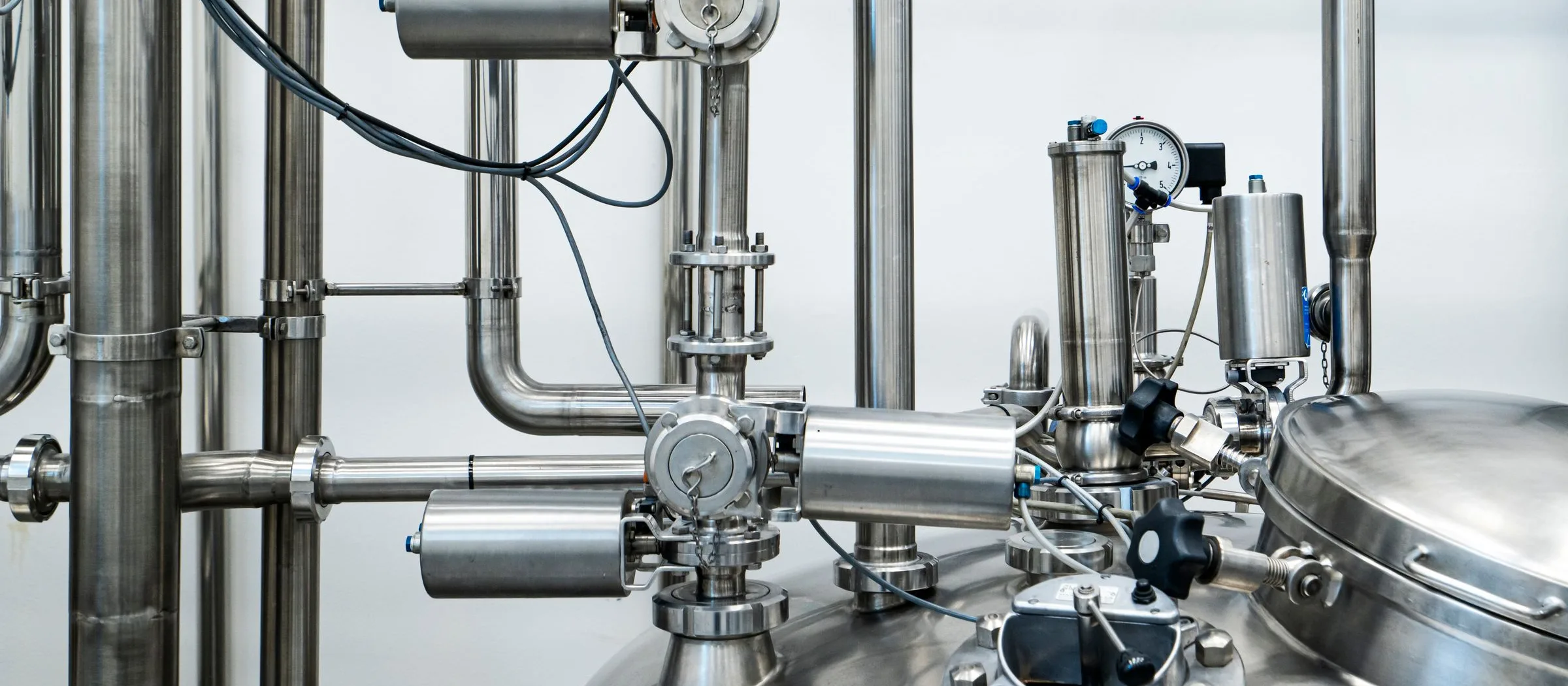
Stainless steel process pipework and valves on a vessel

Industrial Process Utilities

Process cooling water, process water, nitrogen and vacuum, and the mains that bring them to the line.

We design, supply, install, test and commission the utilities of industrial plants, and maintain the systems we installed: process cooling water with its towers, dry coolers, chillers and heat exchangers, process water at the quality each use needs, nitrogen from generators or liquid storage, vacuum for handling, packaging, drying and degassing, and the racks and mains that bring them to the production lines. A plant's compressed air has a page of its own under Compressed Air, and its steam under Steam and Condensate.

The design starts from the process: each user's flow, pressure or vacuum, temperature and purity, how they vary through a shift, and what stops if a utility fails. We size each plant for the peak, with a unit standing by where a stop would cost a batch, place the plants near their users, and run the mains on racks above the lines, each pipe in the material its service needs and identified by its colour and its direction of flow. We design the pipework to ASME B31.3 or EN 13480, and the pressure vessels to EN 13445 or ASME BPVC Section VIII.

We supply the cooling plant, pumps, heat exchangers, nitrogen generators, vacuum pumps, receivers and pipework, those of the brands we carry among them, and our teams install them on site. Each system is pressure tested and flushed, the cooling water treated, and the nitrogen and the vacuum proved at their users for flow, purity and level before handover. Under a service contract we then maintain the systems we installed: plant serviced to its makers' schedules, the cooling water treated and tested, filters and adsorbents changed, and the oil and seals of vacuum pumps renewed.

Process cooling water and process water

Machines, moulds, furnaces and reactors give their heat to a closed loop of treated water, filtered and inhibited so that their small passages never scale or foul. The loop rejects the heat through plate heat exchangers to cooling towers, which at Dubai's design wet bulb of 29 °C give water at about 32 °C, so that the loop runs commonly at 33 to 35 °C; users that need it colder, moulds, lasers and reaction vessels among them, take chilled water from process chillers. The towers run under a water management programme to ASHRAE 188.

Process water goes to each use at the quality it needs: softened for washing and the make-up of cooling systems, reverse osmosis or demineralised water for boiler feed, rinsing and the product itself, and ultrapure water for electronics, made in plants of the kind we describe under Water Treatment. It runs in loops of stainless steel, polypropylene or PVDF that keep it moving and return it to storage, so that it reaches the furthest user as good as it left the plant.

Nitrogen and vacuum

Nitrogen keeps oxygen and moisture away from food, drugs and electronics. Pressure swing adsorption generators make it from the plant's compressed air at commonly 95 to 99.999 per cent purity, membrane generators up to commonly 99.5 per cent, and large or very pure demands take liquid nitrogen from a vacuum-insulated tank through ambient vaporisers. Each generator has a buffer receiver and an analyser that vents gas below its purity, and we fit every room where nitrogen could leak with oxygen monitors that alarm when the oxygen falls below commonly 19.5 per cent.

Vacuum comes from a central plant: oil-lubricated rotary vane pumps down to commonly 1 mbar absolute, dry claw or screw pumps where no oil may reach the process or the exhaust, and liquid ring pumps where the gas is wet. We size the plant from each user's level and flow, with one pump standing by, put a receiver and inlet filters between the users and the pumps, and separators where liquids could be drawn in. A hospital's medical vacuum has its page under Medical Gas Systems.

Systems and equipment

Process cooling

  • Closed cooling loops: treated, filtered and inhibited water for machines, moulds and reactors
  • Plate heat exchangers: between the closed loop and the cooling towers
  • Cooling towers and dry coolers: rejecting the heat the loop collects
  • Process chillers: chilled water for moulds, lasers and reaction vessels
  • Side-stream filters and dosing pots: keeping the loop clean and inhibited

Process water

  • Softened water: for washing and the make-up of cooling systems
  • Reverse osmosis and demineralised water: for boiler feed, rinsing and products
  • Ultrapure water: for electronics, polished at the point of use
  • Distribution loops: stainless steel, polypropylene or PVDF, returning to storage

Nitrogen

  • PSA generators: nitrogen made on site from compressed air, at the purity the process needs
  • Membrane generators: for purities up to commonly 99.5 per cent
  • Liquid nitrogen storage: vacuum-insulated tanks with ambient vaporisers
  • Oxygen monitors: in every room where nitrogen could leak

Vacuum

  • Pumps: rotary vane, dry claw or screw, and liquid ring, with one standing by
  • Receivers and inlet filters: between the users and the pumps
  • Separators: where liquids could be drawn into the system

Standards we work to

  • ASME B31.3: process piping
  • EN 13480: metallic industrial piping
  • EN 13445: unfired pressure vessels
  • CTI STD-201: the performance rating of evaporative heat rejection equipment
  • ASHRAE 188: Legionellosis, risk management for building water systems
  • ISO 21360-1: vacuum technology, standard methods for measuring vacuum pump performance
  • EN 50104: electrical apparatus for the detection and measurement of oxygen