Skip to the content
Red sprinkler risers and valve sets along a factory wall

Fire Protection

Sprinklers, fire pumps, standpipes and hose reels, and clean agent systems for rooms that water would harm.

We design, supply, install, test and commission the fire protection systems of buildings, and maintain the systems we installed: automatic sprinklers and their water supplies, fire pumps and tanks, standpipes, hydrants and hose reels, water mist systems, the clean agent and inert gas systems of rooms that water would harm, the suppression of kitchen hoods, and portable extinguishers. The fire alarm that detects a fire and starts these systems has a page of its own under ELV and Automation.

The design starts from the fire strategy and the hazard of each part of the building: the occupancy classification of NFPA 13 or the hazard class of EN 12845, from which follow the design density, the area of operation, the duration of the water supply and the pressure the pumps must give. A hospital is sprinklered throughout with quick-response sprinklers, since its patients are moved from compartment to compartment rather than out of the building. We design to the UAE Fire and Life Safety Code of Practice in the UAE, and to the NFPA or EN standards the authority and the client require elsewhere.

We supply the pumps, valves, sprinklers, pipework and extinguishing systems, those of the brands we carry among them, each listed or approved for its use, and our teams install them on site. Each sprinkler system is hydrostatically tested, under NFPA 13 at 13.8 bar, or 3.4 bar above its working pressure where that is higher, for 2 hours; the fire pumps are run at churn, at their rated flow and at 150 per cent of it; and the rooms of the gaseous systems pass a door fan test for their hold time, before the authority witnesses the systems at handover. Under a service contract we then maintain the systems we installed: valves exercised, pumps run, sprinklers and agent containers inspected at the intervals the codes set.

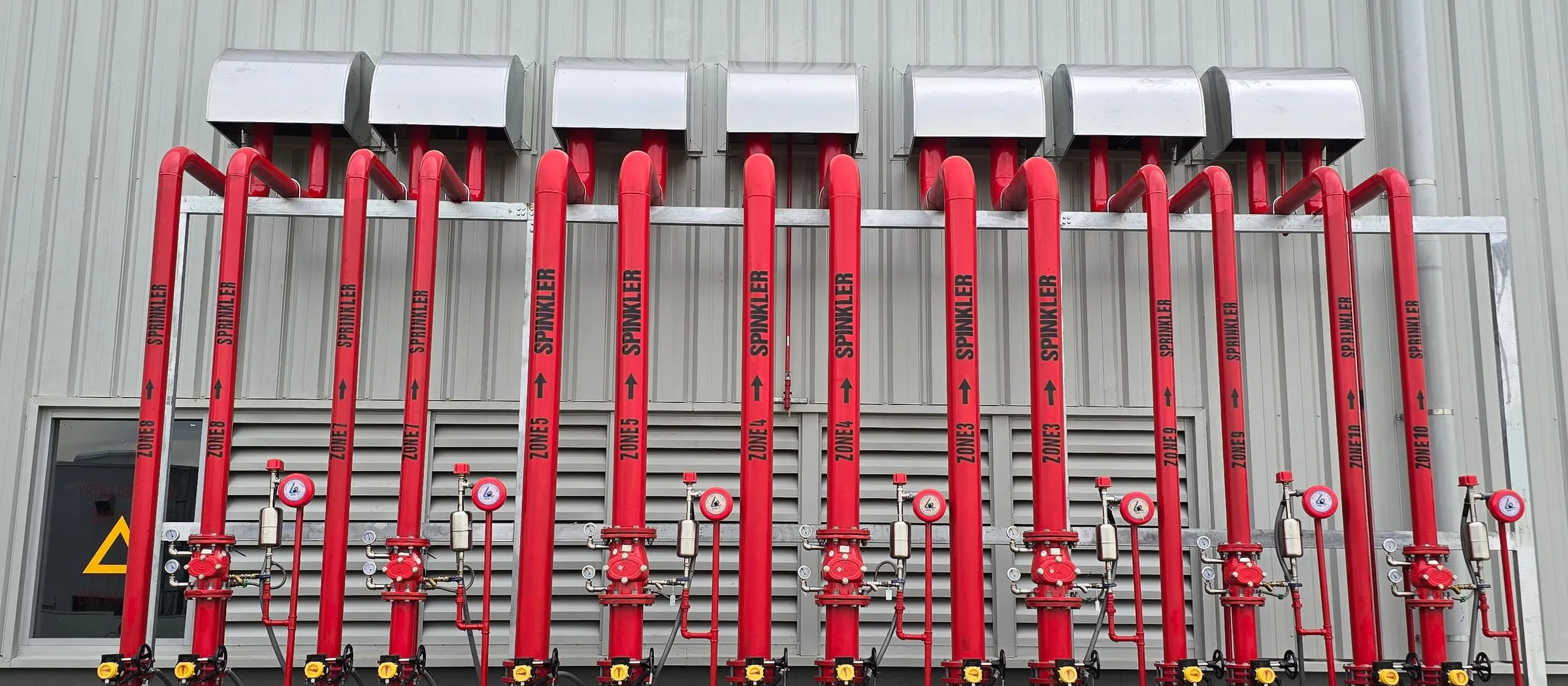
Sprinklers, water supplies and fire pumps

Under NFPA 13 a light hazard occupancy, a hospital ward or an office, takes a design density of 4.1 mm/min over 139 m², and ordinary hazard group 1 takes 6.1 mm/min over the same area; under EN 12845 ordinary hazard group 3 takes 5 mm/min over 216 m². Each system is calculated hydraulically from its most remote area to the pumps. Systems are wet where the pipes cannot freeze, pre-action where an accidental discharge would do harm, as over data halls, and deluge for transformers.

The water supply holds the flow for its duration, commonly 60 minutes for ordinary hazard, in a tank reserved for it. The pumps follow NFPA 20 or EN 12845, commonly an electric main pump, a diesel pump standing by, and a jockey pump that holds the pressure so that the main pumps start only for a fire. Under NFPA 20 each main pump delivers 150 per cent of its rated flow at no less than 65 per cent of its rated pressure, and at churn no more than 140 per cent of its rated pressure.

Standpipes and special extinguishing systems

Standpipes carry water up the stairs to the hose connections the fire service uses. Under NFPA 14 they give a residual pressure of 6.9 bar at the most remote outlet, with 1,893 L/min for the first standpipe and 946 L/min for each one after it, up to 3,785 L/min in a building sprinklered throughout. Hose reels on every floor give the occupants a first means of attack.

Rooms that water would harm, electrical rooms, data halls, archives and the technical rooms of imaging suites, are protected by gaseous systems to NFPA 2001 or ISO 14520: clean agents such as FK-5-1-12 or HFC-227ea discharged within 10 s, or inert gases such as IG-541 within 60 to 120 s, to a design concentration held for at least 10 minutes. We design the room as part of the system, sealed and with pressure relief vents, and prove its hold time with a door fan test. Water mist to NFPA 750 serves where little water is wanted, and kitchen hoods carry wet chemical systems.

Systems and equipment

Sprinkler systems

  • Wet pipe systems: quick-response sprinklers throughout hospitals, offices and public buildings
  • Pre-action and dry pipe systems: where an accidental discharge would do harm or the pipes could freeze
  • Storage sprinklers: early suppression fast response sprinklers for high-piled storage
  • Deluge and water spray systems: for transformers and other high hazards
  • Installation control valves: alarm valves, flow switches, and test and drain valves for each zone

Water supplies and pumps

  • Fire pump sets: an electric main pump, a diesel pump and a jockey pump, to NFPA 20 or EN 12845
  • Pump controllers: a listed controller for each electric and each diesel pump
  • Fire water tanks: sized for the system's flow and duration, with their level indicators
  • Fire mains: grooved or welded steel pipework painted red, and buried yard mains with their hydrants

Standpipes and hose

  • Standpipes and landing valves: wet or dry risers in the stairs, with fire service inlets
  • Hose reels: on every floor, within reach of every part of it
  • External hydrants: on the site's fire main, for the fire service
  • Portable extinguishers: water, foam, carbon dioxide and dry powder, chosen for the risk of each room

Special extinguishing systems

  • Clean agent systems: FK-5-1-12 or HFC-227ea for electrical rooms, data halls and archives
  • Inert gas systems: IG-541 or IG-55 for rooms that must not be wetted
  • Water mist systems: high or low pressure, to NFPA 750
  • Kitchen hood suppression: wet chemical systems on the cooking line, interlocked with the gas supply

Standards we work to

  • NFPA 13: the installation of sprinkler systems
  • NFPA 20: stationary fire pumps
  • NFPA 14: standpipe and hose systems
  • NFPA 2001: clean agent fire extinguishing systems
  • NFPA 750: water mist fire protection systems
  • EN 12845: automatic sprinkler systems
  • ISO 14520: gaseous fire-extinguishing systems
  • The local authority codes of the UAE, the UAE Fire and Life Safety Code of Practice among them