Skip to the content
A boiler room with a steam boiler, a condensate unit and insulated pipework

Steam and Condensate

Steam boilers, clean steam generators and condensate return for sterilisers, laundries and kitchens.

We design, supply, install, test and commission steam systems for hospitals, hotels and industry, and maintain the systems we installed: fire-tube and electric steam boilers with their feedwater and blowdown plant, clean steam generators for sterilisers and humidifiers, the steam mains with their pressure reducing stations and trap sets, and the condensate return that brings the water and its heat back to the boiler house. In a hospital the steam serves the sterile services department, the laundry, the kitchens and the humidifiers of the theatres.

The design starts from the users: the pressure and the quality of steam each needs, and its peak and average demand. From them we size the boilers so that the demand is met with one out of service, the mains for their velocity and pressure drop, and the pressure reducing stations that bring the distribution pressure, commonly 7 to 10 bar, down to what each user takes. We specify the boilers to EN 12953 or to the ASME Boiler and Pressure Vessel Code, with their safety valves, blowdown and feedwater treatment.

We supply the boilers, the clean steam generators, the heat exchangers, the pumps and the valves, those of the brands we carry among them, and our teams install, pipe and insulate them on site. Each boiler is hydraulically tested and commissioned with its manufacturer, its safety valves set, its burner tuned and its water treatment proved, the mains are blown through, and the steam quality at the sterilisers is tested before handover. Under a service contract we then maintain the systems we installed: the boilers inspected and serviced on their schedule, the traps surveyed, the water treatment and blowdown checked.

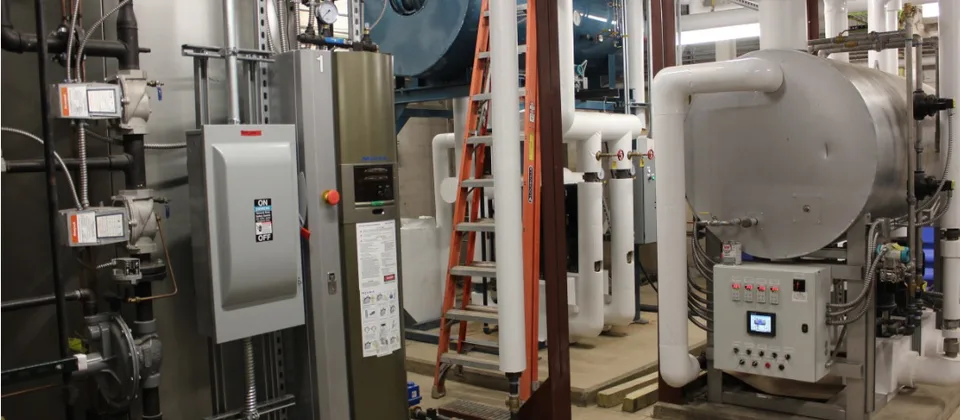
Boilers and clean steam

Three-pass fire-tube shell boilers give most hospitals their steam, fired on gas or oil by modulating burners, with an economiser on the flue and a feed tank kept at 85 to 90 °C, which drives most of the dissolved oxygen out of the water before it reaches the boiler. Treated feedwater and blowdown hold the boiler water within the limits of EN 12953-10, and automatic control of its dissolved solids keeps the blowdown to what the water needs.

Sterilisers need steam that kills by condensing on the load. EN 285 and HTM 01-01 set its quality: no more than 3.5 per cent of non-condensable gases by volume, a dryness value of at least 0.95, or 0.9 for metal loads, and no more than 25 K of superheat when it expands to atmospheric pressure. Plant steam carries the boiler's treatment chemicals, so for sterilisers and for the humidifiers of theatres we generate clean steam from purified water, in a steam-to-steam or an electric generator, and carry it in stainless steel.

Distribution, traps and condensate

The mains are laid to fall in the direction of the steam, with drain pockets and trap sets at every low point and at intervals of 30 to 50 m, so that condensate never gathers to be thrown along the main as water hammer. Each trap set has its strainer, isolating valves and a test point, and we choose each trap for its duty: thermodynamic traps on the mains, float traps on heat exchangers and process equipment that must drain as fast as the steam condenses.

Condensate goes back to the boiler house, its heat and its treated water both worth recovering. Flash steam from high-pressure condensate is recovered in flash vessels for low-pressure users, condensate pumps, electric or pressure-powered, return the rest, and condensate that could be contaminated, from a heat exchanger or a process that could leak, passes a conductivity monitor that diverts it to drain before it reaches the feed tank.

Systems and equipment

Steam generation

  • Fire-tube steam boilers: three-pass shell boilers with modulating burners and economisers
  • Electric steam boilers: electrode or resistance boilers where fuel is not available or the load is small
  • Feedwater plant: a hot feed tank or deaerator, feed pumps, softening or reverse osmosis and dosing
  • Blowdown: automatic dissolved solids control, with a blowdown vessel and heat recovery

Clean steam

  • Clean steam generators: steam-to-steam or electric, from purified water, for sterilisers
  • Steam humidifiers: clean steam or electric steam for theatres and cleanrooms
  • Stainless steel distribution: clean steam pipework and traps of stainless steel
  • Steam quality testing: non-condensable gases, dryness and superheat at the steriliser

Distribution

  • Steam mains: carbon steel, insulated and clad, with drain pockets, anchors and expansion loops
  • Pressure reducing stations: reducing valves in duty and standby pairs with their safety valves
  • Trap sets: thermodynamic, float and thermostatic traps with strainers and test points
  • Separators: removing water droplets ahead of sterilisers and process equipment

Condensate and heat recovery

  • Condensate pumps: electric or pressure-powered, returning condensate to the boiler house
  • Flash recovery: flash vessels feeding low-pressure users
  • Contamination monitoring: conductivity monitors that divert condensate to drain
  • Steam to water heat exchangers: calorifiers and plate heat exchangers for hot water and heating

Standards we work to

  • EN 12953: shell boilers, with part 10 for the quality of feedwater and boiler water
  • ASME BPVC Section I: rules for the construction of power boilers
  • EN 285: large steam sterilisers
  • HTM 01-01: the management and decontamination of surgical instruments, with part C for steam sterilisation
  • EN 13445: unfired pressure vessels
  • ISO 4126-1: safety devices for protection against excessive pressure, safety valves