Skip to the content
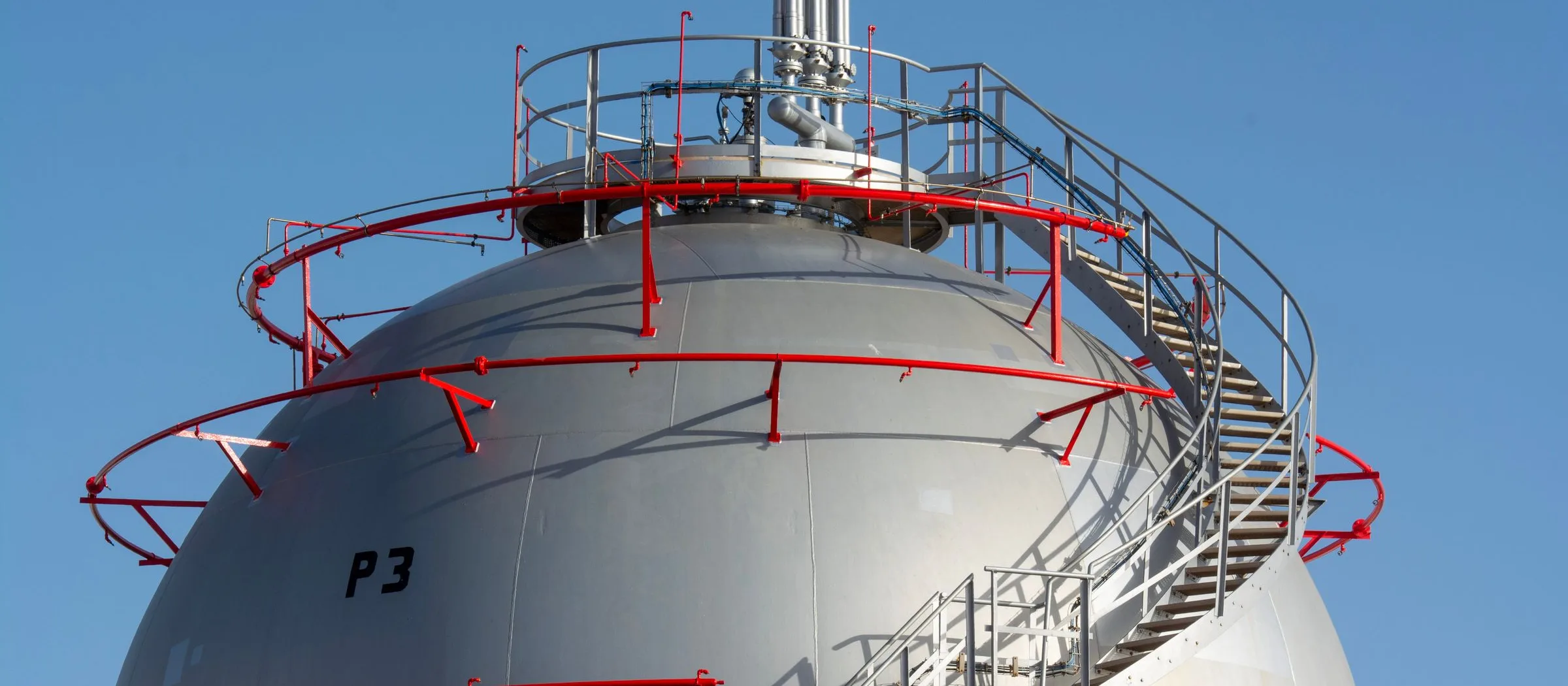
A gas storage sphere with its stair and red railings against a blue sky

Natural Gas and LPG

LPG storage, natural gas supplies, regulators and meters, pipework to the appliances, and gas detection.

We design, supply, install, test and commission the natural gas and LPG systems of buildings, and maintain the systems we installed: LPG tanks and cylinder manifolds with their vaporisers and regulators, the regulator and meter kiosks of natural gas supplies, the pipework to every appliance, and the gas detection and automatic shut-off valves that make the gas safe to use. The gas fuels boilers, steam boilers and cogeneration engines, and serves the kitchens of hospitals, hotels and malls, laboratories, laundries and the apartments of residential towers.

The design starts from the appliances: the gas each burns, its input at full fire, the pressure it needs at its inlet and how many run together. From them we size the storage or the supply, the regulators and the pipework, and lay out the tanks, kiosks and routes with the gas supplier, classifying the hazardous areas around tanks, vents and regulators to IEC 60079-10-1, and rate every electrical item inside them for the gas. In the UAE we design to the UAE Fire and Life Safety Code of Practice and the rules of the authority that licenses gas installations, and to the NFPA or EN standards the project follows elsewhere.

We supply the tanks, regulators, meters, valves, detectors and pipework, those of the brands we carry among them, and our teams install them on site. Each system is pressure tested and purged, each appliance is commissioned at its rated input, and the detection and the shut-off valves are proved together before the supply is connected and the authority approves the installation. Under a service contract we then maintain the systems we installed: regulators and slam-shut valves tested, detectors calibrated, tanks and their fittings inspected, and the pipework checked for leaks.

Storage, regulation and metering

Where no gas network reaches the site, as on many sites in the Gulf, the building takes LPG from tanks above or below ground, at the separation distances NFPA 58 sets by each tank's water capacity, shaded or buried since the pressure in an LPG tank rises with its temperature. A vaporiser makes up any demand beyond what the tanks boil off. A first-stage regulator at the tanks reduces the pressure for the distribution, commonly to between 0.7 and 1.5 bar, and a second-stage regulator at each building or group of appliances to what the appliances are made for.

Natural gas from a network passes a regulator and meter kiosk at the boundary: an inlet valve and a filter, then in each of its streams, commonly two, a slam-shut valve that closes if the outlet pressure goes too high or too low, the regulator with a relief valve after it, and the meter last. We design pipework up to 5 bar to EN 1775, and industrial pipework above 0.5 bar, or any above 5 bar, to EN 15001-1.

Pipework, detection and safe use

NFPA 54 governs the pipework from the point of delivery to the appliances, and NFPA 58 an LPG installation up to that point. Below ground the gas runs in polyethylene to ISO 4437, turning to steel before it leaves the ground; inside, it runs in welded steel or copper, in ventilated routes. Under NFPA 54 the pipework is tested at 1.5 times its maximum working pressure, and at no less than 20 kPa, then purged before gas is let in.

We give each plant room, kitchen and laboratory using gas detectors and an automatic shut-off valve, which closes at a detector's shut-off level, commonly 20 per cent of the lower explosive limit, on the fire alarm or at the emergency button, and is reset only by hand. LPG is heavier than air, so its detectors sit near the floor; natural gas rises, so its detectors sit near the ceiling. Where a commercial kitchen is mechanically ventilated, under BS 6173 its gas supply is interlocked with the ventilation, so that no gas reaches the burners unless the extract runs.

Systems and equipment

LPG storage

  • LPG tanks: above or below ground, with their gauges, relief valves and remote filling points
  • Cylinder manifolds: automatic changeover from the service bank to the reserve, for small users
  • Vaporisers: where the demand exceeds what the tanks give by boiling alone
  • First-stage regulators: at the tanks, from the tank's pressure to the distribution's

Supply and metering

  • Regulator and meter kiosks: filter, slam-shut valves, regulators and relief valves, then the meter
  • Second-stage regulators: at each building or group of appliances
  • Check meters: for kitchens, laboratories, plant rooms and apartments, read remotely
  • Gas boosters: for burners and engines that need more pressure than the supply gives

Pipework

  • Buried mains: polyethylene pipe to ISO 4437, with transition fittings to steel
  • Building pipework: welded steel or copper, sleeved through walls and floors, banded yellow
  • Risers: in ventilated shafts, to the floors and apartments of residential towers
  • Appliance connections: an isolating valve for each appliance, and restrained hoses where it moves

Detection and safety

  • Gas detectors: near the floor for LPG and near the ceiling for natural gas, at two alarm levels
  • Automatic shut-off valves: closing on gas, on the fire alarm or by the emergency button, reset by hand
  • Ventilation interlocks: no gas to a kitchen's burners unless its extract runs
  • Emergency control valves: at the entry to the building and to each kitchen and plant room

Standards we work to

  • NFPA 54: the National Fuel Gas Code
  • NFPA 58: the Liquefied Petroleum Gas Code
  • EN 1775: gas pipework for buildings, at a maximum operating pressure of 5 bar or less
  • EN 15001-1: gas installation pipework above 0.5 bar in industrial installations and above 5 bar in others
  • ISO 4437: plastics piping systems for the supply of gaseous fuels, polyethylene
  • IEC 60079-10-1: explosive atmospheres, the classification of areas for explosive gas atmospheres
  • BS 6173: the installation of gas-fired catering appliances
  • The local authority codes of the UAE, the UAE Fire and Life Safety Code of Practice among them