Skip to the content
Blue air receivers and dryers of a compressed air plant

Compressed Air

Compressor plants, dryers, filters and distribution for plant, instrument and process air, to ISO 8573-1.

We design, supply, install, test and commission compressed air systems for industry, workshops and buildings, and maintain the systems we installed: oil-injected and oil-free compressors, air receivers, dryers and filters, and the distribution that brings plant air, instrument air and process air to the points of use. The medical air and surgical air of a hospital belong to its medical gas pipeline system, which we describe under Medical Gas Systems.

The design starts from the users: the flow each one takes and how often, the pressure it needs at its inlet, and the purity class of ISO 8573-1 its process requires for particles, water and oil. From the demand over a working day we size the compressors so that the base load runs at full output and a variable speed compressor follows the rest, with one unit standing by, choose the dryers and filters for the classes required, and size the pipework for a pressure drop of commonly no more than 0.1 bar from the receiver to the furthest point of use.

We supply the compressors, dryers, filters and receivers, those of the brands we carry among them, and our teams install and pipe them on site. Each system is pressure tested and blown through, the compressors are commissioned with their manufacturers, and the air is tested for its dew point and, where its class requires it, for particles and oil before handover. Under a service contract we then maintain the systems we installed: compressors serviced at their manufacturers' running hours, filter elements and dryer media changed, and leaks found and repaired.

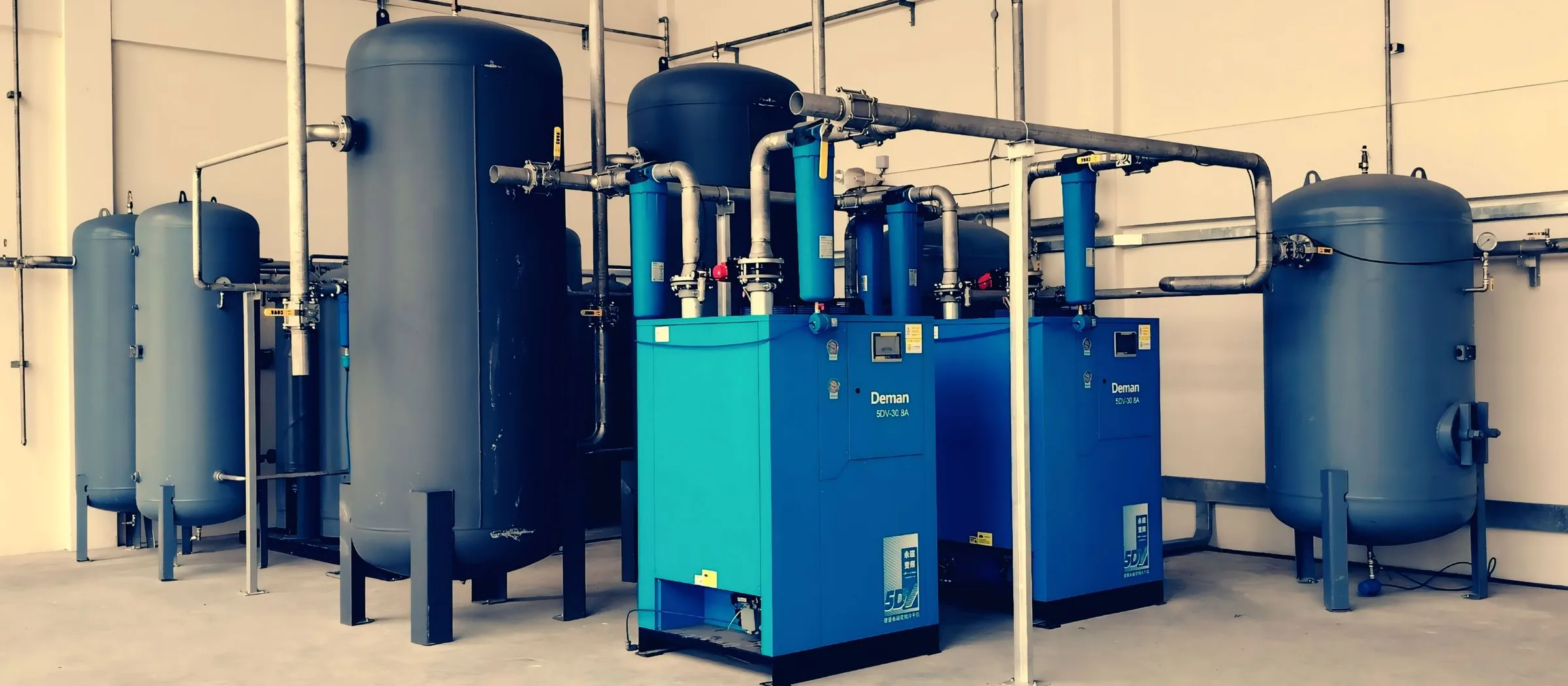
Compressors, dryers and air quality

Most plant air comes from oil-injected rotary screw compressors, filtered down to the oil class the use allows. Where no oil may reach the process, as in food, pharmaceutical and electronics production, we use oil-free compressors, class 0 for oil under ISO 8573-1, so that no filter failure can let oil through. Each compressor's free air delivery is stated to ISO 1217 at its working pressure, commonly 7 to 8 bar for plant air. Nearly all a compressor's energy leaves it as heat, recovered for hot water where the site can use it.

Refrigerant dryers bring the pressure dew point to about 3 °C, class 4 for water, which serves most plant air indoors; desiccant dryers reach −40 °C, class 2, for instrument air, pipework exposed to cold and processes that must stay dry. Coalescing filters tested to ISO 12500 follow a refrigerant dryer and stand ahead of a desiccant dryer, whose desiccant oil would spoil, with a dust filter after it; the condensate of compressors, dryers and filters passes an oil-water separator before it reaches the drain.

Distribution and instrument air

The distribution is a ring main around the building or the production hall, so that every point is fed from two directions, in aluminium, stainless steel or galvanised steel, with each drop taken from the top of the main so that water cannot run into it, and a filter, regulator and lubricator at the points whose tools need them. Receivers stand beside the compressors and beside large intermittent users, so that a sudden demand is met from storage rather than by a fall in pressure across the plant.

Instrument air drives the control valves and actuators of process plants. We design it to ANSI/ISA-7.0.01, with a pressure dew point at least 10 °C below the lowest temperature any part of the system sees, and with a receiver that keeps the valves working long enough after the compressors stop for the plant to be brought to a safe state. Flow and pressure meters let the operator find leaks and assess the system's energy use to ISO 11011.

Systems and equipment

Compressors

  • Oil-injected screw compressors: fixed and variable speed, for plant air
  • Oil-free compressors: screw or scroll, class 0 for oil under ISO 8573-1, for processes no oil may reach
  • Compressor controls: sequencing that runs the base load at full output and the variable speed unit on the rest
  • Heat recovery: hot water from the compressors' oil or air cooling

Treatment

  • Refrigerant dryers: a pressure dew point of about 3 °C for plant air
  • Desiccant dryers: heatless or heated purge, to a pressure dew point of −40 °C, with coalescing filters ahead and a dust filter after
  • Filters: particle, coalescing and activated carbon filters tested to ISO 12500
  • Condensate treatment: drains with level control, and oil-water separators

Distribution

  • Air receivers: beside the compressors and large intermittent users, to EN 286-1 or the pressure vessel code
  • Ring mains: aluminium, stainless steel or galvanised steel, with drops from the top of the main
  • Point-of-use equipment: filters, regulators, lubricators and quick couplings
  • Instrument air systems: dry, oil-free air to ANSI/ISA-7.0.01, with storage for a safe shutdown

Monitoring

  • Flow and pressure meters: at the plant and on the main branches
  • Dew point monitors: on the dryer outlets, alarmed to the plant or building control system
  • Leak detection: ultrasonic surveys of the finished system

Standards we work to

  • ISO 8573-1: compressed air, contaminants and purity classes
  • ISO 1217: displacement compressors, acceptance tests
  • ISO 12500: filters for compressed air, test methods
  • ISO 11011: compressed air, energy efficiency, assessment
  • ANSI/ISA-7.0.01: the quality of instrument air
  • EN 286-1: simple unfired pressure vessels designed to contain air or nitrogen