Skip to the content
A boiler room with a fire-tube boiler, its flue and pipework, in black and white

Heating Systems

Boilers, heat pumps and heating substations, with the hot water circuits that carry their heat.

We design, supply, install, test and commission the heating systems of buildings, and maintain the systems we installed: condensing boilers, air-to-water and water-to-water heat pumps, the plate heat exchangers of substations on a district heating network, the pumps, pipework and pressurisation of the hot water circuits, and the radiators, underfloor heating, fan coil units and air handling unit coils that give the heat to the rooms. In a hospital the same plant feeds the reheat coils that hold the temperature and humidity of the theatres, and the calorifiers of the hot water system.

The design starts from the heat load of each room, calculated to EN 12831-1 or by the method of the ASHRAE Handbook for the design outdoor temperature of the site, and from what the ventilation, the reheat and the hot water need on top of it. We choose flow and return temperatures low enough for condensing boilers and heat pumps to work efficiently, size the plant so that the load is met with one boiler or heat pump out of service, and lay out the circuits, their pumps and their controls to EN 12828 and ASHRAE 90.1.

We supply the boilers, heat pumps, heat exchangers, pumps and valves, those of the brands we carry among them, and our teams install, pipe and wire them on site. Each circuit is pressure tested, flushed and filled with treated water, balanced to its design flows, and its controls are proved through each mode of operation before handover. Under a service contract we then maintain the systems we installed: the boilers serviced and their combustion analysed, the heat pumps checked to their manufacturers' schedules, the water treatment and the pressurisation kept in order.

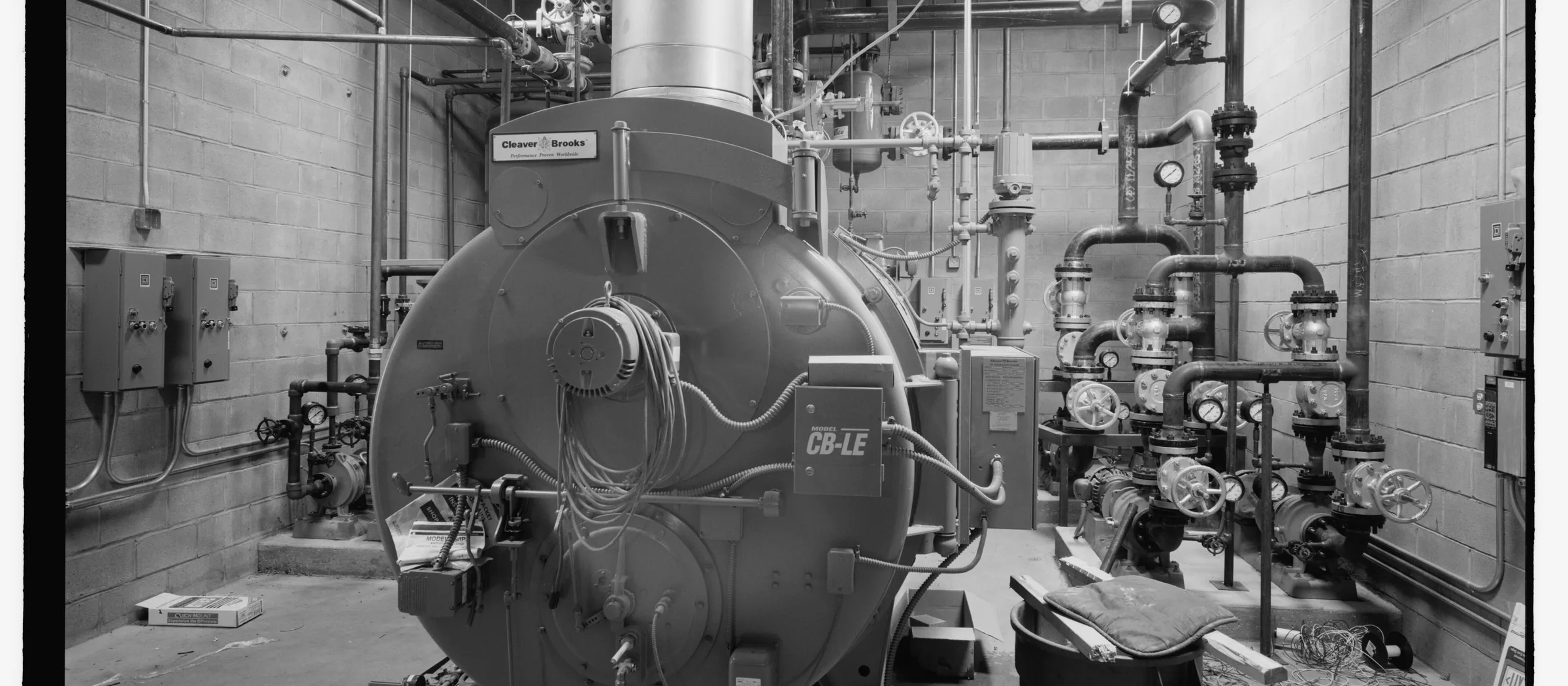
Boilers, heat pumps and substations

A condensing boiler recovers the latent heat of its flue gas only while the return water is below the gas's dew point, about 55 °C for natural gas, so we design its circuits for flow and return temperatures of 70/50 °C or lower. Several boilers stand in cascade on a low loss header, so that each runs in its efficient range and one can be taken out of service while the others carry the load. Air-to-water heat pumps lose capacity and efficiency as the outdoor air cools and their flow temperature rises; we select them at the site's design outdoor temperature for flows of 35 to 55 °C, rated to EN 14511.

Where a district heating network serves the site, a substation of plate heat exchangers separates the network's water from the building's, its control valve holding the secondary flow temperature and its heat meter measuring what the building takes. We size the exchangers for the flow and return temperatures the network operator sets, and for the low return the operator requires.

Hot water circuits, pumps and controls

The circuits carry the heat to radiators sized for each room's load at the circuit's mean water temperature, to fan coil units and air handling unit coils, and to underfloor heating at flows of 35 to 45 °C, designed so that the floor surface stays within the 29 °C EN 1264 sets for the occupied zone. In patient areas the radiators are of the low surface temperature type, at most 43 °C to the touch as NHS guidance sets. Variable speed pumps hold the differential pressure the circuits need, and pressure independent control valves give each terminal its design flow, so that the far end of a circuit is not starved.

Each sealed circuit has a pressurisation unit and expansion vessels sized to EN 12828 for the expansion of its water from fill to maximum temperature, with safety valves and air and dirt separators. We fill it with water treated to VDI 2035, and weather-compensated controls lower the flow temperature as the outdoor air warms.

Systems and equipment

Heat sources

  • Condensing boilers: gas-fired, floor-standing or wall-hung, in cascade on a common flue and a low loss header
  • Air-to-water heat pumps: monobloc or split units for flow temperatures of 35 to 55 °C
  • Water-to-water heat pumps: on ground loops, or recovering the heat the chillers reject
  • Heating substations: plate heat exchangers, control valves and heat meters on a district heating network

Distribution

  • Circulating pumps: variable speed, as duty and standby pairs on each circuit
  • Pipework: steel, copper or multilayer pipe, insulated, with its anchors and expansion compensation
  • Pressurisation and expansion: pressurisation units, expansion vessels and safety valves
  • Air and dirt separators: with magnetic filters on the return to the plant

Heat emitters

  • Radiators: panel radiators with thermostatic valves, and low surface temperature radiators in patient areas
  • Underfloor heating: pipe loops in the screed with their manifolds and room controls, to EN 1264
  • Fan coil units and heating coils: four-pipe fan coil units, reheat coils and the coils of air handling units

Controls and water treatment

  • Weather-compensated controls: the flow temperature reset by the outdoor temperature, with time and room control
  • Control and balancing valves: pressure independent control valves, two-port and three-port valves with their actuators
  • Water treatment: softened or demineralised fill water, dosing pots and side-stream filters
  • Heat meters: on the plant, the substations and each tenant's supply

Standards we work to

  • EN 12828: heating systems in buildings, the design of water-based heating systems
  • EN 12831-1: the calculation of the design heat load for space heating
  • EN 14511: air conditioners, liquid chilling packages and heat pumps with electrically driven compressors
  • EN 15502-1: gas-fired heating boilers, general requirements and tests
  • EN 1264: water-based surface embedded heating and cooling systems
  • VDI 2035: the prevention of damage in water heating installations
  • ASHRAE 90.1: energy performance of buildings