Skip to the content
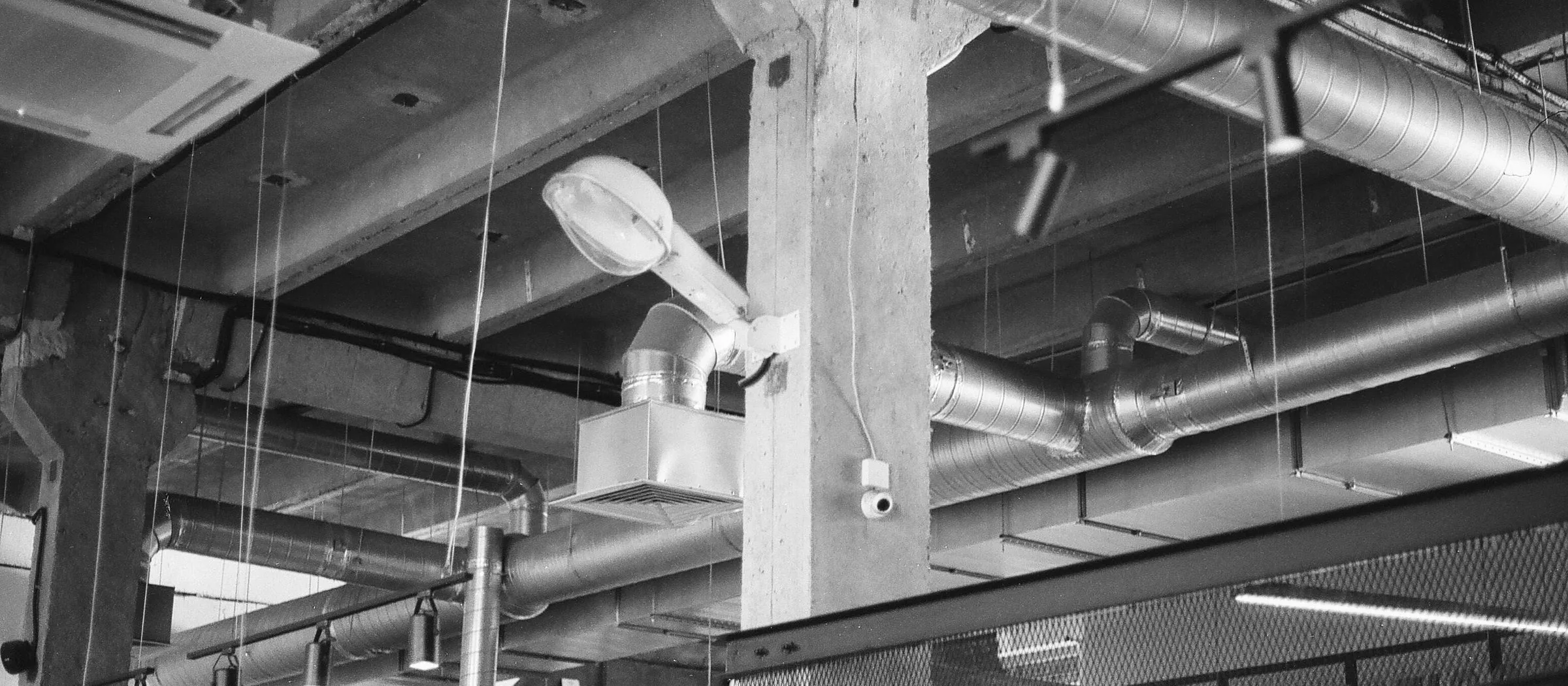
Ducts and pipes hung on rods under a concrete ceiling, in black and white

Seismic Bracing of Services

Bracing and anchorage that hold pipes, ducts, cable trays and plant in place through an earthquake.

We design, supply and install the seismic bracing of building services: the sway braces of pipework, ductwork, cable trays and busbar, the anchorage of chillers, generators, switchboards, tanks and other plant, the restraints of plant on vibration isolators, and the flexible connections that let the services move with the structure where it moves. We design it for the services we install and, where the client asks, for those of other contractors, so that a hospital's services keep it running after an earthquake and no service falls on the people below it.

The design starts from the seismic hazard of the site and the use of the building, as the structural design does. Under chapter 13 of ASCE 7 the force on each component rises with the site's design spectral acceleration, the component's height in the building and its importance factor. In a hospital with surgery or emergency treatment, which ASCE 7 places in Risk Category IV, the components it needs to keep operating take an importance factor of 1.5, as do the life safety systems of any building, the sprinklers among them. Under Eurocode 8 the anchorage of equipment required for life safety systems takes a factor of at least 1.5 too. We calculate each brace and anchor and draw them on the coordinated services drawings.

We supply the braces, anchors, restraints and flexible connections, qualified for seismic loading, and our teams install them with the services. Each brace and anchor is inspected against the approved drawings as the work goes on and before the ceilings close, anchors are proof-loaded where the design requires it, and the equipment that must work after an earthquake is accepted on its maker's seismic certification. Under a service contract we inspect the bracing we installed, and the services it holds, after an earthquake.

Pipework, ductwork and cable trays

Pipes, ducts, cable trays and busbar are braced in two directions, across the run and along it, with steel channel, which takes tension and compression, or with wire rope in opposing pairs, which takes tension alone and suits systems on vibration isolators. Each brace takes the force of the run it holds, and a hanger rod that a rigid brace can push into compression is stiffened. Small pipes and ducts, and those hung close to the slab, are exempt within the limits of ASCE 7, narrower for components with an importance factor of 1.5.

Sprinkler pipework is braced under NFPA 13: lateral sway braces on the mains no more than 12.2 m apart and longitudinal braces no more than 24.4 m apart, closer where the load requires it, and a four-way brace at the top of each riser. A service crosses a seismic joint through a flexible loop that takes the joint's movement, and risers are fixed to take the storey drift, which in a hospital the structure holds to 1 per cent of the storey height.

Equipment, isolators and certification

Plant on a floor or a plinth is anchored for the shear and the overturning the design force gives, with post-installed anchors qualified for cracked concrete and seismic loading under ACI 355.2, or to the seismic categories C1 and C2 of their European Technical Assessment, and designed to ACI 318 or EN 1992-4. Tanks are anchored for the weight of their contents, and suspended plant is braced like the pipework. Plant on vibration isolators stands on restrained spring isolators or between snubbers, which leave the springs free in normal running and hold the machine within a gap of commonly 6 mm or less in an earthquake.

Equipment that must work after the earthquake, as a hospital's generators, chillers, switchboards, UPS systems and medical gas plant must, is certified for that duty by its maker under ASCE 7, commonly on shake-table tests to ICC-ES AC156, and its anchorage is designed for the forces of its certification. Its connections to pipes, ducts and cables are flexible, so that they do not tear when the equipment and the services move apart.

Systems and equipment

Distribution bracing

  • Transverse and longitudinal braces: steel channel or paired wire rope, to the slab or the structure
  • Sprinkler bracing: lateral, longitudinal and four-way braces to NFPA 13
  • Cable tray and busbar bracing: for the trays and trunking of power and data
  • Rod stiffeners: on hanger rods that a rigid brace can put into compression

Equipment anchorage

  • Floor-mounted plant: chillers, generators, switchboards, transformers and tanks anchored for shear and overturning
  • Suspended plant: fan coil units, in-line fans and heaters braced to the slab
  • Post-installed anchors: qualified for cracked concrete and seismic loading
  • Plinths and frames: designed with the structural engineer for the anchor loads

Isolated plant

  • Restrained spring isolators: free in normal running, restrained in an earthquake
  • Snubbers: limiting the movement of machines on isolators to a small gap
  • Cable braces for isolated systems: wire rope braces that leave the isolation working

Joints and certification

  • Seismic joint crossings: flexible loops where services cross the joints of the structure
  • Flexible connections: between braced equipment and its pipes, ducts and cables
  • Seismic certification: the makers' certification of equipment that must work after an earthquake
  • Bracing drawings and calculations: each brace and anchor located and calculated

Standards we work to

  • ASCE 7: minimum design loads and associated criteria for buildings and other structures
  • NFPA 13: the installation of sprinkler systems
  • EN 1998: Eurocode 8, the design of structures for earthquake resistance
  • ACI 318: building code requirements for structural concrete
  • ACI 355.2: qualification of post-installed mechanical anchors in concrete
  • ICC-ES AC156: seismic certification by shake-table testing of non-structural components
  • The local authority codes of the UAE, the Dubai Building Code among them