Skip to the content
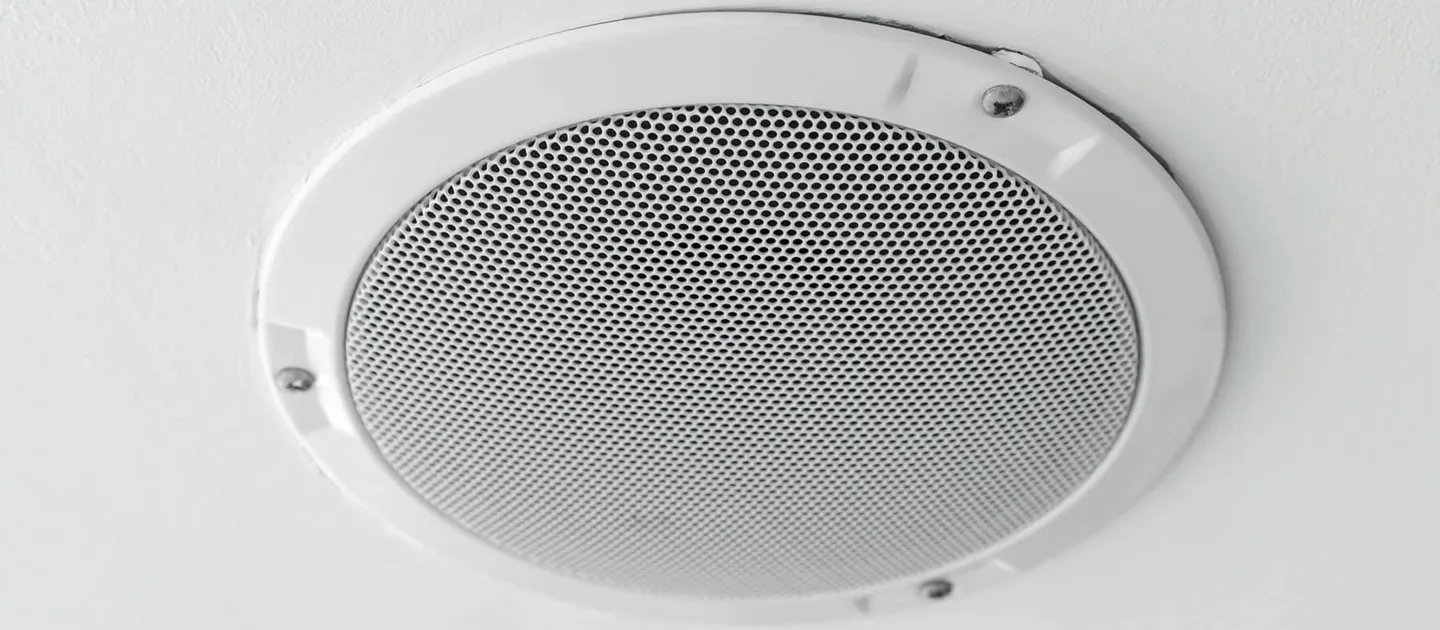
A round loudspeaker set flush in a white ceiling

Public Address and Audio-Visual

Zoned public address and background music, and the audio-visual systems of meeting rooms and halls.

We design, supply, install, test and commission the public address and audio-visual systems of buildings, and maintain the systems we installed: the zoned public address and background music of airports, stations, malls, hospitals and offices, and the sound, displays, cameras, microphones and controls of meeting rooms, conference rooms, lecture halls and auditoriums. Where the public address also carries the voice alarm, it is built from voice alarm equipment to EN 54-16 and EN 54-24, or listed to the UL standards, and designed with it, as Fire Alarm and Voice Evacuation describes.

The design starts from what each space must hear and see: the announcements a hall needs and where they are made from, the music each zone plays, and for each room the people it seats, how they meet, present and call others, and the distance from the screen to its farthest seat. From it we divide the public areas into zones, place the loudspeakers for even coverage and clear speech, size the screens to ANSI/AVIXA V202.01 for the farthest viewer, and set each room's acoustics with the architects, since no system makes a hard, echoing room clear.

We supply the amplifiers, loudspeakers, microphones, displays, cameras, processors and controls, and our teams install them on site. Each zone is measured for its level and its intelligibility, and each room is set up, tuned and tried in each of its uses, from a presentation to a video call, before handover. Under a service contract we then maintain the systems we installed: equipment checked, software and firmware kept current, and rooms retuned when their layout changes.

Public address and background music

Public address is distributed at 100 V from zoned amplifiers to the loudspeakers of each zone, ceiling loudspeakers in offices and shops, column and horn loudspeakers in halls and on platforms, so that a gate, a platform or a floor can be called alone. We design public areas for a speech transmission index of 0.50 or more, measured to IEC 60268-16, the value the voice alarm must reach, at a level commonly 6 to 10 dB above the background noise, which sensors in noisy halls follow by raising the level as crowds gather.

Announcements are ranked: the voice alarm first, then live announcements from the paging stations, then the automatic announcements of flights, trains or closing times, then the background music, which falls silent beneath them. In a hospital we keep routine announcements out of the wards and the rooms where patients sleep, and carry staff messages over the nurse call and the staff's phones instead. Receptions, pharmacy counters and meeting rooms take hearing loops to IEC 60118-4, with a field strength of 400 mA/m at the listener.

Meeting rooms, lecture halls and auditoriums

A meeting room is designed for the way it is used: a display or a projector sized for the farthest seat, ceiling or table microphones with echo cancellation, a camera that frames the table for video calls, and one touch panel that turns it all on. Lecture halls and auditoriums add a lectern, a sound reinforcement system whose coverage across the seats we design to ANSI/AVIXA A102.01, hearing loops, and the recording or streaming of what is said.

Audio and video run over the network: audio to AES67 between processors, microphones and amplifiers, and video over IP from each source to any screen, so that a room can grow without new cabling. Each system is controlled from one processor and reports its state to the network's monitoring, so that a fault is found before the room is next booked. In hospitals the same systems serve the education and meeting rooms, and in universities the teaching rooms.

Systems and equipment

Public address

  • Zoned amplifiers: 100 V outputs for each zone, with a standby amplifier
  • Loudspeakers: ceiling, column, horn and pendant, chosen for each space
  • Paging stations: desk microphones that call one zone, a group of zones or all
  • Ambient noise sensors: raising the level in noisy halls as crowds gather

Announcements and music

  • Message players: the automatic announcements of flights, trains and closing times
  • Background music: sources and schedules for each zone
  • Priorities: the voice alarm first, live announcements next, music last

Meeting and conference rooms

  • Displays and projectors: sized to ANSI/AVIXA V202.01 for the farthest seat
  • Microphones: ceiling or table, with echo cancellation
  • Video conferencing: cameras and codecs for the room's calls
  • Room control: one touch panel for the display, the sound, the lighting and the blinds

Halls and auditoriums

  • Sound reinforcement: coverage across the seats to ANSI/AVIXA A102.01
  • Lecterns: with a microphone, a touch panel and the presenter's inputs
  • Hearing loops: to IEC 60118-4, at receptions, counters, meeting rooms and halls
  • Recording and streaming: lectures and events captured for the network

Signal transport and control

  • Audio over IP: to AES67 between processors, microphones and amplifiers
  • Video over IP: any source to any screen in the building
  • Monitoring: the state of every device reported over the network

Standards we work to

  • IEC 60268-16: sound system equipment, the objective rating of speech intelligibility by speech transmission index
  • EN 54-16 and EN 54-24: voice alarm control and indicating equipment, and voice alarm loudspeakers
  • EN 50849: sound systems for emergency purposes
  • IEC 60118-4: induction loop systems for hearing aid purposes, system performance requirements
  • ANSI/AVIXA V202.01: display image size for 2D content in audiovisual systems
  • ANSI/AVIXA A102.01: audio coverage uniformity in enclosed listener areas
  • AES67: high-performance streaming audio-over-IP interoperability