Skip to the content
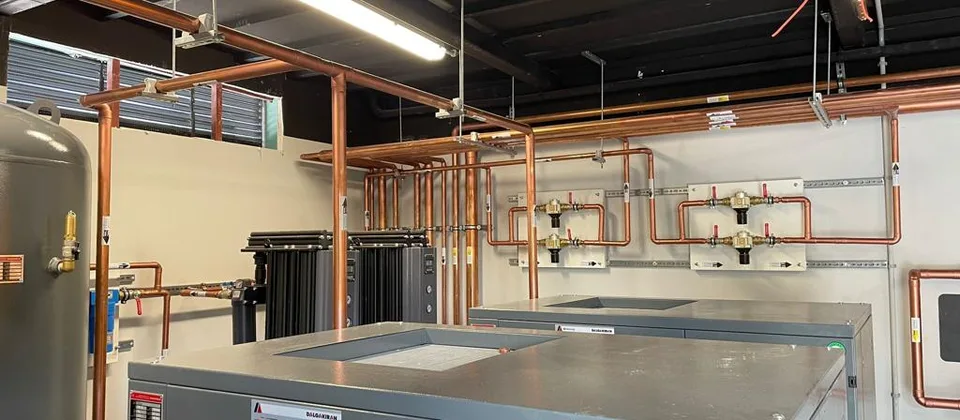
A medical gas plant room with compressors, a receiver and copper pipework on the wall

Medical Gas Systems

Medical gas pipeline systems for hospitals, from the plant room to the terminal unit at the bed.

We design, supply, install, test and commission the medical gas pipeline systems of hospitals and clinics, and maintain the systems we installed. A system carries the gases a hospital uses at the bed and in the operating theatre: oxygen, nitrous oxide and its mixture with oxygen, medical air, surgical air, carbon dioxide and medical vacuum. It runs from the sources of supply in the plant rooms to the terminal units of the wards, the intensive care units and the theatres, and in the theatres a system of its own scavenges the anaesthetic gases the patient breathes out.

The design starts from the hospital's clinical brief: the gases each room needs and the number of terminal units, from which we work out the demand of each department and the flow each pipeline must carry. We size the plant and the pipelines, divide the hospital into zones that can be isolated, place the alarms and choose the medical supply units for each kind of room, to HTM 02-01 and ISO 7396-1, or to NFPA 99 where a project follows American codes.

We supply the plant, the manifolds, the area valve service units, the terminal units and the medical supply units from the brands we carry, and our installation teams build the systems on site. Each system is tested for leaks, cross-connections, flow, pressure, particles, gas identity and purity before the hospital takes it into use. Under a service contract we then maintain the systems we installed: the plant serviced to its manufacturers' schedules, the filters and dryers changed, the alarms and the area valves tested.

Pipelines, area valves and terminal units

The pipelines are seamless copper tubes degreased for oxygen service to EN 13348 and delivered capped. Our installers braze the joints under a nitrogen purge, so that no oxide forms inside the pipe, and label each pipeline with its gas and direction of flow; each section is pressure tested before its ceiling is closed. We size the pipelines so that every terminal unit receives its pressure at the design flow: a nominal 400 kPa for the medical gases, 700 to 800 kPa for surgical air, and for vacuum at least 40 kPa below atmospheric.

Each department is a zone with an area valve service unit at its entrance, so that staff can shut off a ward in an emergency and isolate a zone for work while the rest of the hospital keeps its gases. At the bed, terminal units that accept only their own gas's probe are set in bedhead units on the wards, ceiling beams in intensive care and pendants in the theatres, to the British, German or French probe standard the hospital has chosen.

Plant, sources of supply and alarms

Each compressed gas has a primary, a secondary and a reserve source of supply, so that the hospital keeps its gas through a failure. Oxygen comes from a liquid oxygen tank, a concentrator plant or cylinder manifolds that change over on their own from the running bank to the standby bank. Medical air comes from oil-free compressors through dryers and filters, its dew point and carbon monoxide monitored; vacuum from pumps with receivers and duplex bacteria filters. Each plant meets the design flow with any one of its units out of service.

The alarms follow the three categories of ISO 7396-1: operating alarms at the plant for the technical staff, emergency operating alarms where staff are present at all times, and emergency clinical alarms at the nurse base of every zone. The emergency alarms sound when the pressure of a compressed gas moves more than 20 per cent from its nominal value or the vacuum weakens, and name the gas and the fault. We connect plant and alarms to the building management system where there is one.

Systems and equipment

Sources of supply

  • Oxygen concentrator plants: duplex or triplex pressure swing adsorption units with their receivers, and boosters that fill the reserve cylinders
  • Cylinder manifolds: automatic changeover from the running bank to the standby bank, for oxygen, nitrous oxide, carbon dioxide and gas mixtures
  • Medical and surgical air plants: oil-free compressors with desiccant dryers, filters, and dew point and carbon monoxide monitors
  • Vacuum plants: rotary vane or claw pumps with receivers and duplex bacteria filters
  • Anaesthetic gas scavenging: duplex pumps serving the disposal terminal units of the theatres

Distribution

  • Pipelines: seamless degreased copper tubes, brazed under a nitrogen purge and labelled by gas and direction of flow
  • Area valve service units: lockable isolation valves for each zone, with an emergency inlet for each gas
  • Line pressure regulators: duplex sets that hold each gas at its distribution pressure, a nominal 400 kPa, or 700 to 800 kPa for surgical air
  • Zone pressure sensors: on each gas in each zone, feeding the clinical alarms

At the bed and in the theatre

  • Terminal units: a socket specific to each gas that accepts only its probe, for oxygen, nitrous oxide, medical air, surgical air and vacuum
  • Bedhead units: horizontal or vertical trunking on the wards, carrying the terminal units with power, data, nurse call and lighting
  • Ceiling pendants: fixed or motorised, single or double arm, for surgery, anaesthesia and endoscopy
  • Intensive care beams and bridges: ceiling supply units that keep the floor around the bed clear
  • Flowmeters and suction controllers: oxygen flowmeters with humidifiers, vacuum regulators with collection jars

Alarms and monitoring

  • Operating alarms: the faults of each compressor, pump, dryer and manifold, at the plant for the technical staff
  • Emergency operating alarms: the pressure of each gas leaving its plant, where the hospital's staff are present at all times
  • Emergency clinical alarms: the pressure of each gas in the zone, at the nurse base of every ward
  • Building management interface: the plant and alarm states passed on over Modbus or BACnet

Standards we work to

  • HTM 02-01: medical gas pipeline systems
  • ISO 7396-1: medical gas pipeline systems for compressed medical gases and vacuum
  • ISO 7396-2: anaesthetic gas scavenging disposal systems
  • NFPA 99: health care facilities, their medical gas and vacuum systems among them
  • EN 13348: seamless round copper tubes for medical gases or vacuum
  • ISO 9170-1: terminal units for compressed medical gases and vacuum
  • ISO 11197: medical supply units