Skip to the content
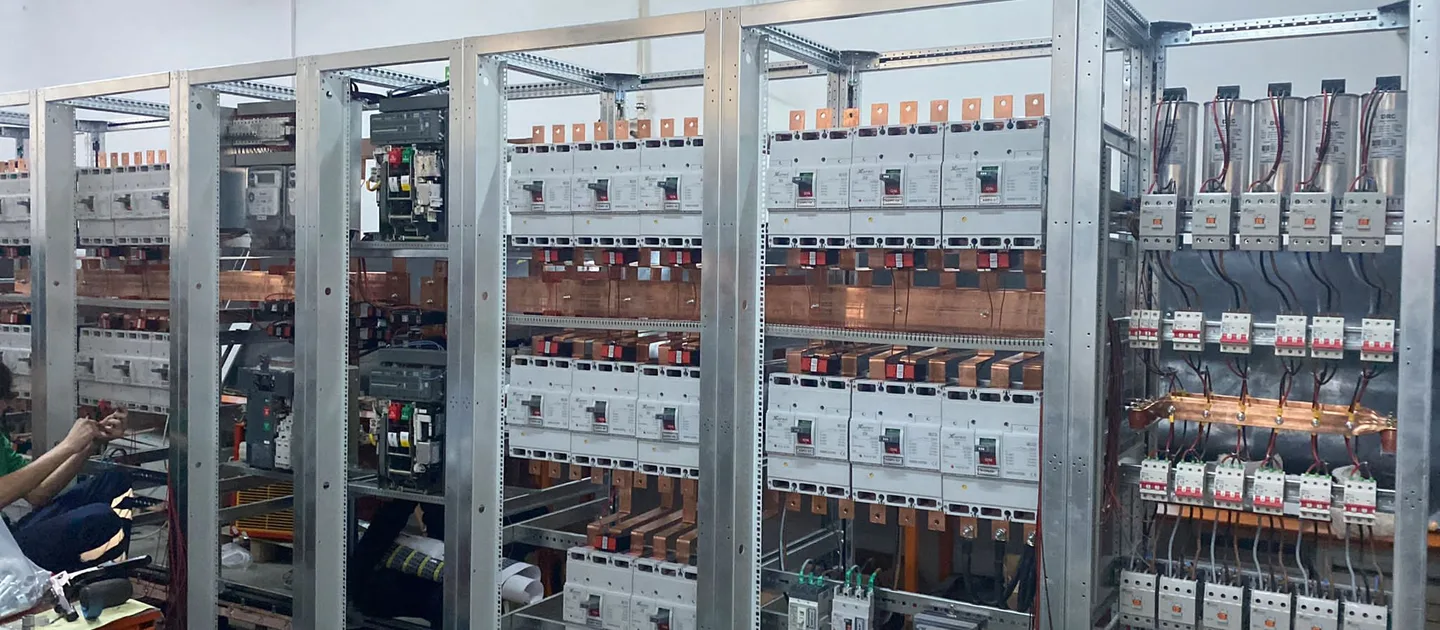
A low-voltage switchboard under assembly, breakers mounted on copper busbars in open frames

Low Voltage Distribution

Low-voltage distribution from the main switchboard to the final circuit, sized for its loads and its faults.

We design, supply, install, test and commission the low-voltage distribution of buildings, and maintain the systems we installed: the main switchboards at the transformers, the busbar trunking and the cables of the risers, the sub-main and final distribution boards, the motor control centres of the plant, and the power factor correction, metering and surge protection that go with them. A building is most often supplied at 400/230 V, 50 Hz, and distributed as a TN-S system from its transformers.

The design starts from a load schedule of every board with its diversity, and from the fault level at the transformers. We size each cable and busbar for its load, for the ambient temperature of the site and the grouping it is laid in, for the voltage drop at its far end and for the fault it must withstand; we choose the breakers so that the one nearest a fault trips and those upstream stay closed; and in a hospital we divide the distribution into the normal and the essential sections the standby supply feeds, to IEC 60364 and the authority's regulations.

We supply the switchboards, the busbar trunking, the breakers and the distribution boards from the brands we carry, the boards built by assembly manufacturers to designs verified under IEC 61439, and our teams install and connect them on site. Before it is energised each board is tested for insulation resistance, continuity, polarity, earth fault loop impedance and the operation of its residual current devices, and its protection settings are set and recorded. Under a service contract we then maintain the systems we installed: thermographic surveys under load, connections checked, breakers operated and tested.

Main switchboards and assemblies

A main switchboard stands at each transformer, with an air circuit breaker for the incomer, air or moulded case circuit breakers for the risers and the plant, and a bus coupler where two transformers share the load or back each other up. We specify each board as an assembly verified to IEC 61439-1 and IEC 61439-2, rated for the prospective fault current at its busbars, commonly 50 or 65 kA for 1 s, with internal separation of form 4b, so that a feeder can be isolated and worked on while the others stay in service.

The incomers and the large feeders carry electronic trip units with long-time, short-time, instantaneous and earth fault settings, and measure the energy and the power quality they pass. Power factor correction banks with detuned reactors hold the power factor at 0.95 or above without amplifying the harmonics of drives and other non-linear loads, active harmonic filters bring the current distortion down where the loads require it, and Type 1 or Type 2 surge protective devices protect each main board.

Busbars, cables and final circuits

In tall buildings and large plant rooms the risers are busbar trunking to IEC 61439-6, with tap-off units at each floor, and the sub-mains are copper cables with XLPE insulation, armoured where they are buried and low smoke and zero halogen wherever people gather or are cared for. The cables of the life safety systems, fire pumps, smoke extract, fire alarm and emergency lighting, are fire resistant and routed apart from the rest.

We size every circuit for its voltage drop as well as its load: commonly no more than 3 per cent for lighting and 5 per cent for other uses, the values IEC 60364-5-52 gives for a supply from the public network, though it allows more from a building's own transformers. Selectivity between the breakers is checked on their time-current curves and the manufacturers' tables, so that a fault on a final circuit trips only its own breaker. Socket outlets and the final circuits people touch carry residual current devices of 30 mA, of Type A, F or B to suit the load.

Systems and equipment

Main switchboards

  • Main low-voltage switchboards: assemblies verified to IEC 61439-2, form 4b, rated for the fault level
  • Air circuit breakers: incomers, bus couplers and large feeders, with electronic trip units
  • Automatic changeover: between transformers, and between the mains and the generators on essential sections
  • Metering: multifunction meters and power analysers on the incomers and the main feeders

Distribution

  • Busbar trunking: risers and plant room busbars with tap-off units, to IEC 61439-6
  • Sub-main distribution boards: moulded case circuit breakers for each floor and each plant item
  • Final distribution boards: miniature circuit breakers and residual current devices
  • Motor control centres: starters and variable speed drives for the mechanical plant

Power quality and protection

  • Power factor correction: automatic capacitor banks with detuned reactors
  • Active harmonic filters: for the current distortion of drives, UPS systems and LED lighting
  • Surge protective devices: Type 1 and Type 2 at the main and sub-main boards
  • Residual current protection: 30 mA devices on socket outlets and final circuits

Cables and containment

  • Power cables: copper with XLPE insulation, armoured where buried, low smoke and zero halogen indoors
  • Fire-resistant cables: for fire pumps, smoke extract, fire alarm and emergency lighting
  • Cable trays, ladders and trunking: hot-dip galvanised steel, sized for the cables and their spacing
  • Wiring accessories: socket outlets, switches and isolators for each room

Standards we work to

  • IEC 60364: low-voltage electrical installations, with part 7-710 for medical locations
  • IEC 61439-1 and IEC 61439-2: low-voltage switchgear and controlgear assemblies
  • IEC 61439-6: busbar trunking systems
  • IEC 60947-2: low-voltage switchgear and controlgear, circuit-breakers
  • IEC 60502-1: power cables with extruded insulation for 1 kV and 3 kV
  • BS 7671: requirements for electrical installations, the IET Wiring Regulations
  • The regulations of the UAE's electricity authorities, those of DEWA in Dubai among them